Tuesday, June 9, 2009

Analyzing SolrNet with NDepend

I've been using NDepend off and on for the last couple of years. Mainly to diagnose build issues and help me write build scripts for complex legacy applications, since legacy applications with no automated build often fall into cyclic dependencies between different solutions. NDepend's assembly build order feature is great for this. But I've never had the time to really dive into the myriad other features this product offers.

A couple of weeks ago Patrick Smacchia kindly sent me a Pro license for NDepend (thanks Patrick!), so I thought it would be a great opportunity to use it to analyze SolrNet. Now, SolrNet is by all measures a tiny project (ohloh stats are inflated due to Sandcastle, SHFB, etc being in the trunk), but that doesn't mean it can't benefit from NDepend.

First of all, if you're analyzing a library, I recommend that you include your tests in the analysis, so that NDepend can see how the library is actually used. Otherwise, NDepend will suggest that you mark some things as private when it shouldn't. Don't worry about the tests raising warnings in the analysis, you can filter them out as I'll explain later. Plus, having the ability to analyze the tests can be pretty handy too.

For example, we can easily issue some CQL queries to get the code/test ratio:

SELECT ASSEMBLIES WHERE NameLike "Tests" 1972 LOC (as defined here)
SELECT ASSEMBLIES WHERE !NameLike "Tests" 1550 LOC

So the code:test ratio is 1:1.27, more LOC of tests than code! However, keep in mind that this metric alone doesn't imply a correct coverage.

Browsing the default queries, I find that "Fields that could be declared internal" caught a

public readonly string query;

Oops, fixing right away!

Under "Purity / Immutability / Side-Effects", "Fields should be marked as ReadOnly when possible" showed 29 results, which seemed strange since I always try to make my objects immutable. 24 of these were <>l__initialThreadId fields, which is one of the fields of the iterator that the C# compiler builds when you use yield return. This also happened with the "Methods too big", "Methods too complex" and "Potentially unused methods" metrics.

Of course, you can edit or delete the default CQL queries. For example, the "Potentially unused methods" is defined by default as:

// <Name>Potentially unused methods</Name>
WARN IF Count > 0 IN SELECT TOP 10 METHODS WHERE 
 MethodCa == 0 AND            // Ca=0 -> No Afferent Coupling -> The method is not used in the context of this application.
 !IsPublic AND                // Public methods might be used by client applications of your assemblies.
 !IsEntryPoint AND            // Main() method is not used by-design.
 !IsExplicitInterfaceImpl AND // The IL code never explicitely calls explicit interface methods implementation.
 !IsClassConstructor AND      // The IL code never explicitely calls class constructors.
 !IsFinalizer                 // The IL code never explicitely calls finalizers.

We can easily add another condition so that these methods don't bother us: AND !FullNameLike "__"

One of the most useful features of NDepend is comparing two versions of a project. I compared the latest release of SolrNet against trunk. Here's a chart of added methods (83 in total, in blue):
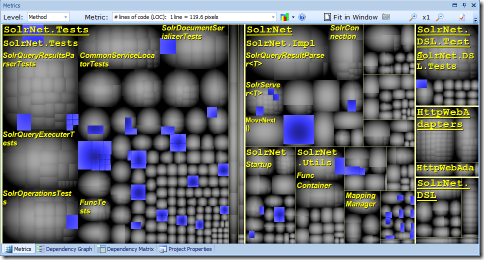
83 methods added

34 methods changed:

methods-changed

API breaking changes (no graphic here, just a list):

api-breaking-changes

Don't worry, these are all internal breaking changes, they won't affect the library consumer...

From these graphics you can immediately see that there aren't really many changes, and they aren't focused. The reason is that most of the changes are minor bugfixes and a couple of minor added features.

I only scratched the surface of what's possible with NDepend, but as you can see, small projects can also profit from it, so check it out!


Sunday, May 31, 2009

Duck typing extensions for Windsor

Whenever you have to use some piece of legacy code that's badly designed (i.e. static, no coding to interfaces, god classes), your own code gets tainted with some unwanted dependencies or it gets harder to test because of that unmockable legacy code.

The usual cure for this is to isolate the legacy code with adapters, factories, etc. But what if the legacy code isn't so bad? What if we only need to extract an interface? The resulting adapter would be just trivially forwarding calls to the real object... which is boring code. Can't we do better?

After my last post I've been playing a bit more with David Meyer's Duck Typing Project (aka DeftTech) and thought it would be nice to have the ability to expose a registered Windsor component under one or more duck-typed interfaces. Kind of like forwarded types, but without having the service actually implement those interfaces.

So I came up with a couple of simple extension methods that allow this:

public class Duck {
    public bool HasQuacked { get; private set; }
    public bool HasSwum { get; private set;}

    public void Quack() {
        HasQuacked = true;
    }

    public void Swim() {
        HasSwum = true;
    }
}

public interface IQuack {
    void Quack();
}

public interface ISwimmer {
    void Swim();
}

[Test]
public void WindsorDuckTyping() {
    var container = new WindsorContainer();
    DuckComponentExtensions.Kernel = container.Kernel;
    container.AddFacility<FactorySupportFacility>();
    container.Register(Component.For(typeof(Duck))
        .Duck<IQuack>()
        .Duck<ISwimmer>());
    ISwimmer swimmer = container.Resolve<ISwimmer>();
    swimmer.Swim();
    IQuack quack = container.Resolve<IQuack>();
    quack.Quack();
    Duck duck = container.Resolve<Duck>();
    Assert.IsTrue(duck.HasQuacked);
    Assert.IsTrue(duck.HasSwum);
}

So the Duck can be resolved as IQuack even though it doesn't implement IQuack. Here's the code that enables this:

public static class DuckComponentExtensions {
    public static IKernel Kernel { get; set; }

    public static ComponentRegistration<object> Duck<TDuck>(this ComponentRegistration<object> reg) {
        var targetType = reg.Implementation ?? reg.ServiceType;
        if (!DuckTyping.CanCast<TDuck>(targetType))
            throw new ApplicationException(string.Format("Can't duck type '{0}' to type '{1}'", targetType, typeof(TDuck)));
        Kernel.Register(Component.For<TDuck>()
                            .UsingFactoryMethod(k => DuckTyping.Cast<TDuck>(k.Resolve(reg.Name, reg.ServiceType))));
        return reg;
    }
}

Full source code with tests available here.
Apparently the proxies generated by DeftTech can't be proxied by DynamicProxy... so don't try to define any interceptors for these components! Again, the optimal solution would be to implement proper duck-typing with DynamicProxy...

Monday, May 25, 2009

Duck typing with Castle DynamicProxy

I was trying to come up with some duck typing solution using C# 4.0, based on this, and this, when I realized that DynamicProxy could do this without any new language features:

using System;
using System.Collections.Generic;
using System.Linq;
using System.Text;
using Castle.Core.Interceptor;
using Castle.DynamicProxy;
using Microsoft.VisualStudio.TestTools.UnitTesting;

namespace DuckTypingTests {
    public class Duck {
        public void Quack() {
            Console.WriteLine("Quack Quack!");
        }

        public void Swim() {
            Console.WriteLine("Swimming...");
        }
    }

    public interface IQuack {
        void Quack();
    }

    public interface ISwimmer {
        void Swim();
    }

    [TestClass]
    public class DuckTypingTests {
        [TestMethod]
        public void DuckTyping() {
            var duck = new Duck();
            duck.As<IQuack>().Quack();
            duck.As<ISwimmer>().Swim();
        }
    }

    public static class DuckTypingExtensions {
        private static readonly ProxyGenerator generator = new ProxyGenerator();

        public static T As<T>(this object o) {
            return generator.CreateInterfaceProxyWithoutTarget<T>(new DuckTypingInterceptor(o));
        }
    }

    public class DuckTypingInterceptor : IInterceptor {
        private readonly object target;

        public DuckTypingInterceptor(object target) {
            this.target = target;
        }

        public void Intercept(IInvocation invocation) {
            var methods = target.GetType().GetMethods()
                .Where(m => m.Name == invocation.Method.Name)
                .Where(m => m.GetParameters().Length == invocation.Arguments.Length)
                .ToList();
            if (methods.Count > 1)
                throw new ApplicationException(string.Format("Ambiguous method match for '{0}'", invocation.Method.Name));
            if (methods.Count == 0)
                throw new ApplicationException(string.Format("No method '{0}' found", invocation.Method.Name));
            var method = methods[0];
            if (invocation.GenericArguments != null && invocation.GenericArguments.Length > 0)
                method = method.MakeGenericMethod(invocation.GenericArguments);
            invocation.ReturnValue = method.Invoke(target, invocation.Arguments);
        }
    }
}

Again, this is just a spike, it only matches methods, not properties, and even the method matching in the interceptor will break with method overloading. And let's not mention performance.

It would be interesting to somehow merge David Meyer's Duck Typing Project into Castle DynamicProxy, as it is the most complete duck-typing solution for .net that I know...

Testing private methods with C# 4.0

Here's another practical use for dynamic in C# 4: testing private methods. I won't discuss here whether this should or shouldn't be done, that's been argued to death for years. Instead, I'll show how it can be done easier with C# 4, without resorting to reflection (at least not directly) or stubs, while also reducing some of the friction associated with doing TDD in statically-typed languages like C#.

The answer is very simple: we just walk away from static typing using C# dynamic:

public class Service {
    private int Step1() {
        return 1;
    }
}

[TestClass]
public class TransparentObjectTests {
    [TestMethod]
    public void PrivateMethod() {
        dynamic s = new Service().AsTransparentObject();
        Assert.AreEqual(1, s.Step1());
    }
}

When going dynamic, it's kind of like turning off the compiler, so, for example, it won't bother you at compile-time if a method isn't present. Instead, you'll just get an exception when you run your test, which is more like the dynamic language way of testing things.

Here's the code that enables this. Just like my last post, it's just a spike, it's incomplete and I didn't test it properly, but it could serve as a base for a more complete implementation:

using System;
using System.Dynamic;
using System.Linq;
using System.Reflection;
using Microsoft.CSharp.RuntimeBinder;
using Microsoft.VisualStudio.TestTools.UnitTesting;

namespace DynamicReflection {
    public class Service {
        private int Step1() {
            return 1;
        }

        protected int Step2() {
            return 2;
        }

        internal int Step3() {
            return 3;
        }

        private int Prop { get; set; }

        public int Execute(int a) {
            return Step1() + Step2() + Step3() + a;
        }

        private string ExecuteGeneric<T>(T a) {
            return a.ToString();
        }
    }

    [TestClass]
    public class TransparentObjectTests {
        [TestMethod]
        public void PublicMethod() {
            dynamic s = new Service().AsTransparentObject();
            Assert.AreEqual(10, s.Execute(4));
        }

        [TestMethod]
        public void PrivateMethod() {
            dynamic s = new Service().AsTransparentObject();
            Assert.AreEqual(1, s.Step1());
        }

        [TestMethod]
        public void ProtectedMethod() {
            dynamic s = new Service().AsTransparentObject();
            Assert.AreEqual(2, s.Step2());
        }

        [TestMethod]
        public void InternalMethod() {
            dynamic s = new Service().AsTransparentObject();
            Assert.AreEqual(3, s.Step3());
        }

        [TestMethod]
        public void PrivateProperty() {
            dynamic s = new Service().AsTransparentObject();
            Assert.AreEqual(0, s.Prop);
        }

        [TestMethod]
        [ExpectedException(typeof(ArgumentException))]
        public void GenericPrivateMethod_type_mismatch() {
            dynamic s = new Service().AsTransparentObject();
            s.ExecuteGeneric<int>("lalal"); // type param mismatch
        }

        [TestMethod]
        public void GenericPrivateMethod() {
            dynamic s = new Service().AsTransparentObject();
            Assert.AreEqual("1", s.ExecuteGeneric<int>(1));
        }
    }

    public static class TransparentObjectExtensions {
        public static dynamic AsTransparentObject<T>(this T o) {
            return new TransparentObject<T>(o);
        }
    }

    public class TransparentObject<T> : DynamicObject {
        private readonly T target;

        public TransparentObject(T target) {
            this.target = target;
        }

        public override bool TryGetMember(GetMemberBinder binder, out object result) {
            var members = typeof(T).GetMember(binder.Name, BindingFlags.Public | BindingFlags.NonPublic | BindingFlags.Instance);
            var member = members[0];
            if (member is PropertyInfo) {
                result = (member as PropertyInfo).GetValue(target, null);
                return true;
            }
            if (member is FieldInfo) {
                result = (member as FieldInfo).GetValue(target);
                return true;
            }
            result = null;
            return false;
        }

        public override bool TryInvokeMember(InvokeMemberBinder binder, object[] args, out object result) {
            var csBinder = binder as CSharpInvokeMemberBinder;
            var method = typeof(T).GetMethod(binder.Name, BindingFlags.Public | BindingFlags.NonPublic | BindingFlags.Instance);
            if (method == null)
                throw new ApplicationException(string.Format("Method '{0}' not found for type '{1}'", binder.Name, typeof(T)));
            if (csBinder.TypeArguments.Count > 0)
                method = method.MakeGenericMethod(csBinder.TypeArguments.ToArray());
            result = method.Invoke(target, args);
            return true;
        }
    }
}

UPDATE 5/17/2010: Igor Ostrovsky recently got the same idea outlined here and has written a proper implementation of this.

Saturday, May 23, 2009

Rails-like finders for NHibernate with C# 4.0

Now that VS2010 Beta 1 is out, I figured I'd take another look and try to actually do something with it. So I spiked a little proof of concept for what I mentioned about six months ago: Rails-like finders for NHibernate. In RoR's ActiveRecord you can write:

Person.find_by_name("pepe")

without really having a find_by_name method, thanks to Ruby's method_missing. Now, with a few lines of code, you can write this in C# 4.0, thanks to DynamicObject:

ISession session = ...
Person person = session.AsDynamic().GetPersonByName("pepe");

which behind the scenes will parse the method name "GetPersonByName" (using a Pascal-Casing convention) into a DetachedCriteria and execute it.

Note that I wrote "Person person = ..." instead of "var person = ...", that's because the result of GetPersonByName() is a dynamic so it has to be cast to its proper type to jump back to the strongly-typed world.

As I said before, this is only a proof of concept. It doesn't support finders that return collections, or operators (as in FindPersonByNameAndCity("Pepe", "Boulogne-sur-Mer")), etc. It would certainly be interesting to really implement this, but I wonder if people would use it, with IQueryable being more strongly-typed, way more flexible, and with better language integration.

Anyway, here's the code that makes this possible. Pay no attention to Castle ActiveRecord, I just used it because... well, geographical convenience, really.

using System;
using System.Collections;
using System.Collections.Generic;
using System.Dynamic;
using System.Linq;
using System.Text.RegularExpressions;
using Castle.ActiveRecord;
using Castle.ActiveRecord.Framework.Config;
using log4net.Config;
using NHibernate;
using NHibernate.Criterion;
using NUnit.Framework;

namespace NHDynamicTests {
    [TestFixture]
    public class DynamicTests {
        [Test]
        public void DynamicGetPersonByName() {
            using (ISession s = ActiveRecordMediator.GetSessionFactoryHolder().GetSessionFactory(typeof(object)).OpenSession()) {
                dynamic ds = s.AsDynamic();
                Person person = ds.GetPersonByName("pepe");
            }
        }

        [ActiveRecord]
        public class Person {
            [PrimaryKey]
            public int Id { get; set; }

            [Property]
            public string Name { get; set; }
        }

        [TestFixtureSetUp]
        public void FixtureSetup() {
            BasicConfigurator.Configure();
            var arConfig = new InPlaceConfigurationSource();
            var properties = new Dictionary<string, string> {
                {"connection.driver_class", "NHibernate.Driver.SQLite20Driver"},
                {"dialect", "NHibernate.Dialect.SQLiteDialect"},
                {"connection.provider", "NHibernate.Connection.DriverConnectionProvider"},
                {"connection.connection_string", "Data Source=test.db;Version=3;New=True;"},
            };

            arConfig.Add(typeof(ActiveRecordBase), properties);
            ActiveRecordStarter.ResetInitializationFlag();
            var arTypes = GetType().GetNestedTypes()
                .Where(t => t.GetCustomAttributes(typeof(ActiveRecordAttribute), true).Length > 0)
                .ToArray();
            ActiveRecordStarter.Initialize(arConfig, arTypes);
            ActiveRecordStarter.CreateSchema();
        }
    }

    public static class ISessionExtensions {
        public static dynamic AsDynamic(this ISession session) {
            return new DynamicSession(session);
        }
    }

    public class DynamicSession : DynamicObject {
        private readonly ISession session;

        public DynamicSession(ISession session) {
            this.session = session;
        }

        public override bool TryInvokeMember(InvokeMemberBinder binder, object[] args, out object result) {
            result = null;
            if (!binder.Name.StartsWith("Get"))
                return false;
            var tokens = Regex.Replace(binder.Name, "([A-Z])", " $1").Split(' ').Skip(1).ToArray();
            if (tokens.Length < 4 || args.Length < 1)
                return false; // some parameter is missing
            var typeName = tokens[1];
            var type = session.SessionFactory.GetAllClassMetadata()
                .Cast<DictionaryEntry>()
                .Select(e => e.Key).Cast<Type>()
                .FirstOrDefault(t => t.Name == typeName);
            if (type == null)
                throw new ApplicationException(string.Format("Type '{0}' is not mapped in NHibernate", typeName));
            var fieldName = tokens[3];
            var criteria = DetachedCriteria.For(type).Add(Restrictions.Eq(fieldName, args[0]));
            result = criteria.GetExecutableCriteria(session).UniqueResult();
            return true;
        }
    }
}

BTW: I just can't stand WPF's font rendering, it's so blurry! I don't care if it uses Ideal Width or Compatible Width or whatever you want to call it, it just looks very bad. Please vote for this issue so they fix it as soon as possible!